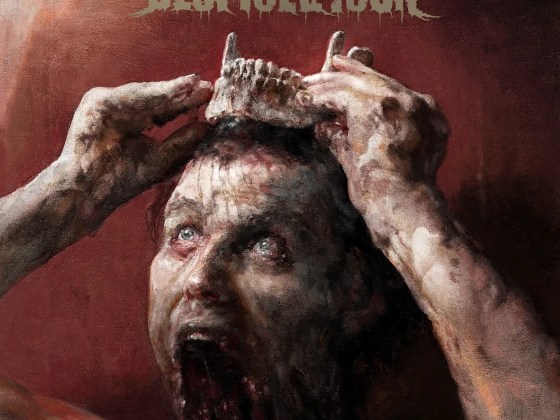

First new Volumes, now new Textures? Teenage-me is reveling in such abundance. Present-day me is soaking in nostalgia of earlier, simpler times, where we were young, progressive metalcore was young, and the internet was young.
The Dutch prog/modern metallers in Textures, along with Tesseract and Periphery, formed the first wave of Meshuggah-spawned bands. The heralds of their percussive and flamboyant version of progressive metal, with modern sensibilities, created the “djent” wave that carried forth through the decades to the present day, paving the path for countless other bands to follow in their footsteps. But these three bands, for most of us who lived in that era, were the firstborn.
While Periphery has been prolific in its catalog, and Tesseract were consistent in putting out new material. I reviewed their latest record, 2023’s War of Being HERE. Through that time, Textures felt notably absent and fondly missed. As a young initiate of the genre, I voraciously devoured the catchy riffs that abounded on their first three records, Polars, Drawing in Circles, and most notably, Silhouettes, which for many was THE Textures record. As my tastes grew away from the genre, I largely skipped over Dualism and their last record, 2016’s Phenotype. However, when the sequel to the thematic twin-album, Genotype, crossed my table, I owed it to my past self to jump right back on the Textures-train.
The singles to welcome their latest record felt like a warm welcome to the Textures sound. Second track of the record, following the intro-lude “Void”, “At the Edge of Winter” is a triumphant return to form. With guest vocals, courtesy of Charlotte Wessels (of Delain fame), the track opens with bombastic electronica before hitting us with those early 2000s-era djenty chugs. The track has modern sensibilities with all kinds of studio black magic overdubs. With a catchy belted-out chorus hook, the track neatly ties together and serves as a great example to showcase this new era of Textures. In contrast, the next single, “Vanishing Twins,” feels like a rumbling beast, with its rolling drums and some Leprous-esque elements, which is always welcome. Textures continues to stick to more triumphant sounds, mirroring Tesseract, while Periphery dips its toes into darkness more often. Nonetheless, the closing breakdown on “Vanishing Twin” shows that Textures still have teeth to bare. The final single, “Closer to the Unknown,” has a bouncy bridge, yet feels like a lesser follow-up to the energetic “At the Edge of Winter” and the push-forward “Vanishing Twin.”
While there are soaring moments on tracks like “A Seat for Like-Minded” and “Measuring the Heavens”, much of Genotype feels like a paler imitation of what Tesseract has been putting out, and a slowed-down version of what Monuments has sharpened into a precise weapon. Even the sonorous synth-laden sections feel like something Leprous has been doing for a while now, and better. There are a few vocal lilts like those on the album closer, the eight-minute “Walls of the Soul”, that hint at more exotic textures (heh). I wish the band leaned heavier into these novel elements, instead of writing music that leans more on nostalgia than innovation.
Undeniably, Textures is full of proficient musicians. Foundational guitarists Bart Hennephof and newer Joe Tal can write progressive djent with the best of them. Hennephof and his riffs on Silhouettes formed a cornerstone upon which my love for this genre was built. The ingenuity of fellow guitarist Joachem Jacobs feels ostensibly missing. Vocalist Daniel de Jongh is belting out multi-register vocals throughout the runtime of Genotype. From growled sections (sorely missing on Tesseract) to croons that would make Dan Tompkins nod appreciatively. His more aggressive vocals were among my favorite elements on this record, when juxtaposed with the expansive musical arrangements. These arrangements are largely from the mind of keyboardist Uri Dijk. In an era where most synths and strings are at the hands of studio producers, to have an actual musician at the keys is immediately apparent in the presence of the keyboard arrangements of the record. Textures isn’t Textures, without the founder, the bedrock of the band, the man Stef Broks behind the kit. Textures is his child, and his drumwork on Genotype is more testament to why the genre took off at the sheer velocity it did.
Consuming Genotype, and this new iteration of Textures as a metalhead, further along his own refinement of taste, found this record heartily beckoning to nostalgia. However, to be judged with my present, admittedly more critical ear, this record fails to capture much of that earlier magic. New fans to the band will enjoy Genotype, as will those who are able to separate legacy and comparison and appreciate a work of music as it is. For others, like me, the magic lies in memory.
-
Overall Sound7/10 GoodConsuming 'Genotype', and this new iteration of Textures as a metalhead, further along his own refinement of taste, found this record heartily beckoning to nostalgia
-
Songwriting & Lyrics7/10 GoodGenotype feels like a paler imitation of what Tesseract has been putting out, and a slowed-down version of what Monuments has sharpened into a precise weapon.